



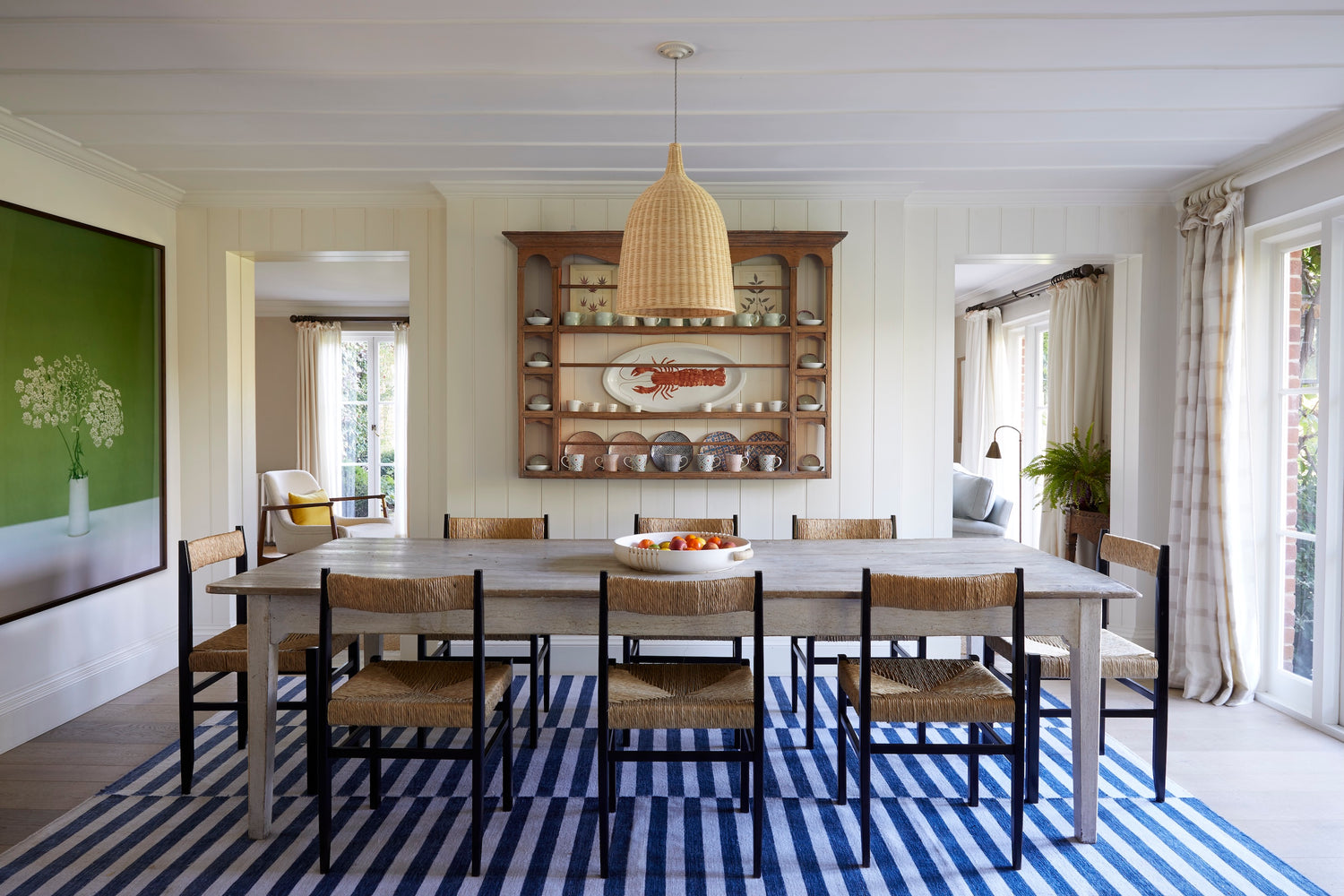
Interiors and product, shaped by the same design approach
Studio Atkinson brings together interiors and product within one considered approach. Furniture, lighting, textiles, wallpaper and accessories are developed in house, informed by years of interiors practice and a deep understanding of how people live.
Each piece is designed with clarity and care, with a focus on proportion, material and detail. Created to sit comfortably within a range of settings, the collection reflects the same warmth and quiet confidence found across the studio’s interior work.
Featured Collections


Susie Atkinson Interiors

Commercial Interiors
A portfolio of commercial interiors designed with clarity and care, shaped by material, proportion and a considered understanding of how spaces are used.

Residential Interiors
A portfolio of residential interiors shaped by how people live, brought together with warmth, balance and a close attention to material, proportion and detail.
Journal

Lighting for Darker Evenings: Creating Layers of Light
As the evenings draw in, lighting becomes an increasingly important part of how we experience our homes. A considered mix of light sources can transform the atmosphere of a room, bringing warmth, depth and a sense of intimacy. For Susie, lighting has always been about creating different layers rather than relying on a single source. Table lamps, wall lights and pendants can each bring something different to a room, creating small pools of light and allowing particular corners, objects, artworks and surfaces to gently come into focus. As Susie says, “lamps are my favourite because they cast a softer, lower level light”. A table lamp beside a sofa can bring warmth to an otherwise quiet corner. Pieces such as the Dionis Table Lamp and Plato Light work particularly well in this way, with the Parsons Desk Light bringing a more focused light - each piece provides decorative interest whilst making a space inviting and cosy. “lamps are my favourite because they cast a softer, lower level light” The ability to adjust lighting is just as important as the fittings themselves. Susie prefers lamps to operate separately from spotlights and pendants, with dimmers used “so that you can set the mood”. Diffusers can make the light more mellow, while warmer bulbs create a gentler atmosphere as evening falls. Wall lights are another way to introduce warmth and interest without illuminating a whole room, and are a fantastic way to draw attention to an artwork or architectural feature. The Parsons and Dionis Wall Lights work particularly well in this way, bringing both character and warmth while also leaving space for shadow. Susie equally considers where light is not needed. “I avoid spotlights in bedrooms unless they are directional for artwork”, she explains. Instead, she uses tiny uplighters within deep window reveals to “give a nice glow and frame the window”. It is a subtle distinction but an important one. Darkness and shadow can be as much part of the atmosphere as the areas we choose to illuminate. The light itself can also become part of the character of a room. Susie has long enjoyed combining traditional interiors with contemporary elements, including “interesting lighting” alongside artwork and sculptural furniture. The Fyning Pendant, for example, can introduce light from above but is an accent piece in its own right. Ultimately, the most inviting rooms rarely rely on one source of light. They are built from layers, with each one serving a different purpose and coming into its own at different moments of the day. It is about balance, and in Susie’s words, “essential are dimmers and warm white light bulbs!”
Learn more
A Room Needs a Point of Focus
When entering a room, the eye will instinctively settle on something - a piece of furniture, an artwork, an architectural detail or perhaps a beautiful fabric. Having this point of focus gives a room a sense of balance, and makes the rest of the scheme feel more considered. Without it, a space can feel a little unresolved. When several elements are competing for attention, it can be harder to appreciate each one individually. The room becomes a collection of parts rather than a considered whole. Establishing a point of focus brings a quiet order, allowing each element to sit comfortably in relation to something else. It doesn’t need to be particularly bold. Often the most successful focal points are quite understated: a sofa positioned in the right place, upholstered walling, a large mirror or artwork. It is less about creating a ‘statement’ and more about giving a space something to centre itself around. From there, other elements can play a complimentary role and restraint plays an important role. Mixing quieter pieces with those that have a little more presence allows individual furniture, fabrics and objects to be properly appreciated rather than competing with one another, creating a sense of balance. Materiality often also contributes to this too. Variations in textures, finishes & materials can naturally draw the eye and add depth to a room. A glossy lacquered surface against a natural abaca rug, for example, can create a subtle interest and contrast without feeling overly deliberate. There is also a relationship between focal points and the way you move through a space. In larger rooms, or where several spaces connect, different points of interest can naturally draw the eye from one area to the next. This might be a piece of furniture, an artwork, a view through a doorway or an architectural detail. Rather than everything being taken in at once, these moments give the room a gentle sense of rhythm and a sense of progression, allowing the space to unfold gradually rather than all at once. The idea is not to create a statement for its own sake, but to give the room a centre. When this is achieved, everything else begins to align around it. The space feels more composed, and each element is understood more clearly in relation to the whole. A room does not require many moments of emphasis. Often, a single point of focus is enough. It provides clarity, allowing the rest of the space to remain calm and considered.
Learn more
Laid Bare: A Collection Shaped by Craft, Simplicity and Enduring Design
Born from years of designing interiors, Laid Bare is Studio Atkinson’s founding furniture collection. Explore the thinking behind the designs, the craftsmanship that defines each piece and the enduring philosophy that continues to shape the collection today.
Learn more